Premium inflatable art · Expertise
What stands between a drawing and a piece on its feet.
3D design, patterning, high-frequency welding, airbrushed decor, backlighting, installation by rope-access technicians. All of it described here, with no shortcuts.
From sketch to structure
 Enlarge
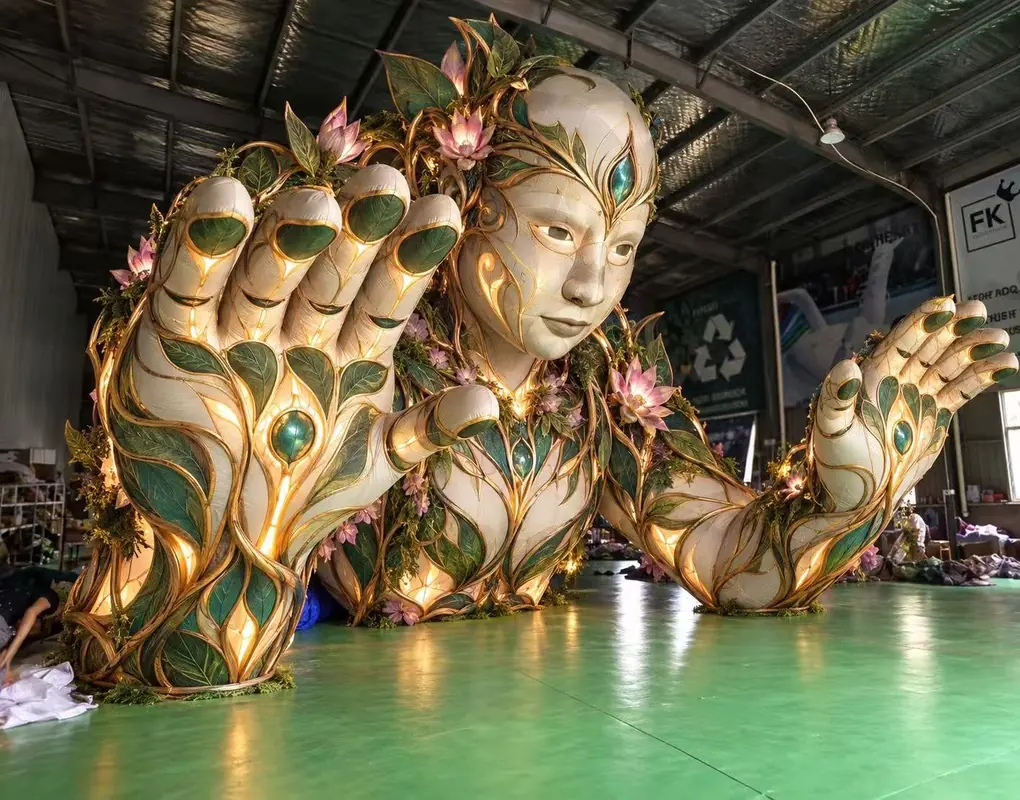
What comes out of the workshop is what was drawn.
Five stages on a single board: first intentions, volume study, proposed corrections, detailed drawing, colour. Every piece goes through this before a single metre of fabric is cut, and the drawing is what you validate.
The character above is the one on the board: same face, same leaf work, same gold linework. It is the test we hold ourselves to.
Method
01Understanding the brief
We study what you send: sketch, illustration, 3D model or photo of the character, along with the site, the dates and the intended use.
02Adapting to an inflatable volume
Not every shape holds under air. We redraw the volume so it stands, reads from a distance and keeps the character recognisable.
03Validation
3D renders in situation, day and night. We agree on dimensions, finishes, backlighting and anchoring before anything is cut.
04Manufacture and checks
Patterning, high-frequency welding, reinforced seams, airbrushed or printed decoration, LED fitting, then a full inflation test in the workshop.
05Delivery
Packing, transport, and a handover file: blowers, anchoring kit, assembly notes and power requirements.
06Installation by our teams
Assembly on site under the agreed conditions, rope access for suspensions and high points, standby during operation, then dismantling.
What you provide
- ·A visual reference: sketch, illustration, 3D model (OBJ, FBX, STL) or simply photos.
- ·The site: dimensions, indoor or outdoor, access, ceiling height or anchor points.
- ·Dates, duration of use, and who the audience is.
- ·Licence clearance if the character belongs to a rights holder.
What we take care of
- ·Technical feasibility study and adaptation of the volume.
- ·3D renders, prototyping and material choices.
- ·Manufacture, decoration, lighting and in-house testing.
- ·Fire classification documents and a wind calculation note.
- ·Transport, assembly, on-site standby, dismantling and storage.
The file you validate
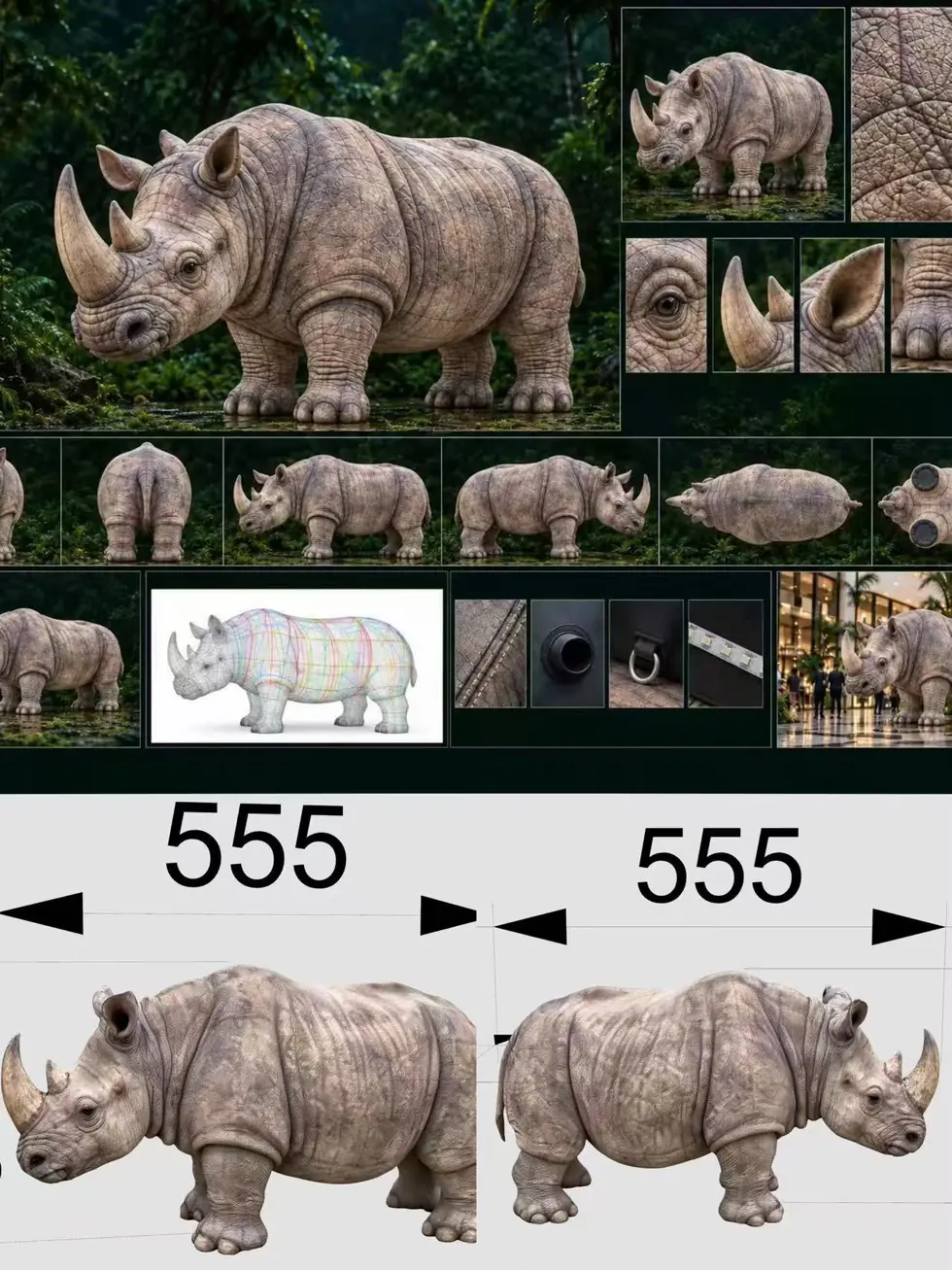
Nothing is built before you have seen all of it.
- Views
- The piece rendered from every angle, plus close-ups of the texture, eye, horn and ear.
- 3D mesh
- The modelled volume, which is what the patterns are cut from.
- Hardware
- Seam, inflation valve, anchor ring and LED strip, photographed close up.
- Dimensions
- Measured elevations, so you can check the piece against your own plan.
- In situation
- The piece placed in a venue like yours, at the right scale, with people in frame.
This file is what you sign. It leaves no room for a surprise on delivery day: the piece that arrives is the piece in these images.
Materials and blowers
- Fabric
- Polyester-backed PVC, 610 to 900 g/m²: sealed pieces and long runs.
- Fabric
- Coated ripstop polyester: constant-air structures, lighter, faster to rig.
- Diffusion
- Translucent fabric: internal LED backlighting, readable day and night.
- Decoration
- Airbrush or print: hand-painted gradients, or sublimation across the whole surface.
- Light
- DMX-controllable RGB LEDs: can be synced with the event lighting desk.
- Fire rating
- M2 · DIN 4102 B1: the classification safety committees ask for.
- Type
- Centrifugal blower, constant air
- Power
- 0,37 à 2,2 kW
- Airflow
- 1 200 à 4 500 m³/h
- Pressure
- 250 à 1 500 Pa
- Supply
- 230 V single · 400 V three-phase
- Protection
- IP44 à IP55
- Noise
- 65 to 85 dB(A), acoustic housing optional
On larger pieces we fit two blowers with automatic changeover and a non-return flap: the structure stays up if one stops. Size any generator at three times the rated power to absorb the starting current.
Installation and logistics
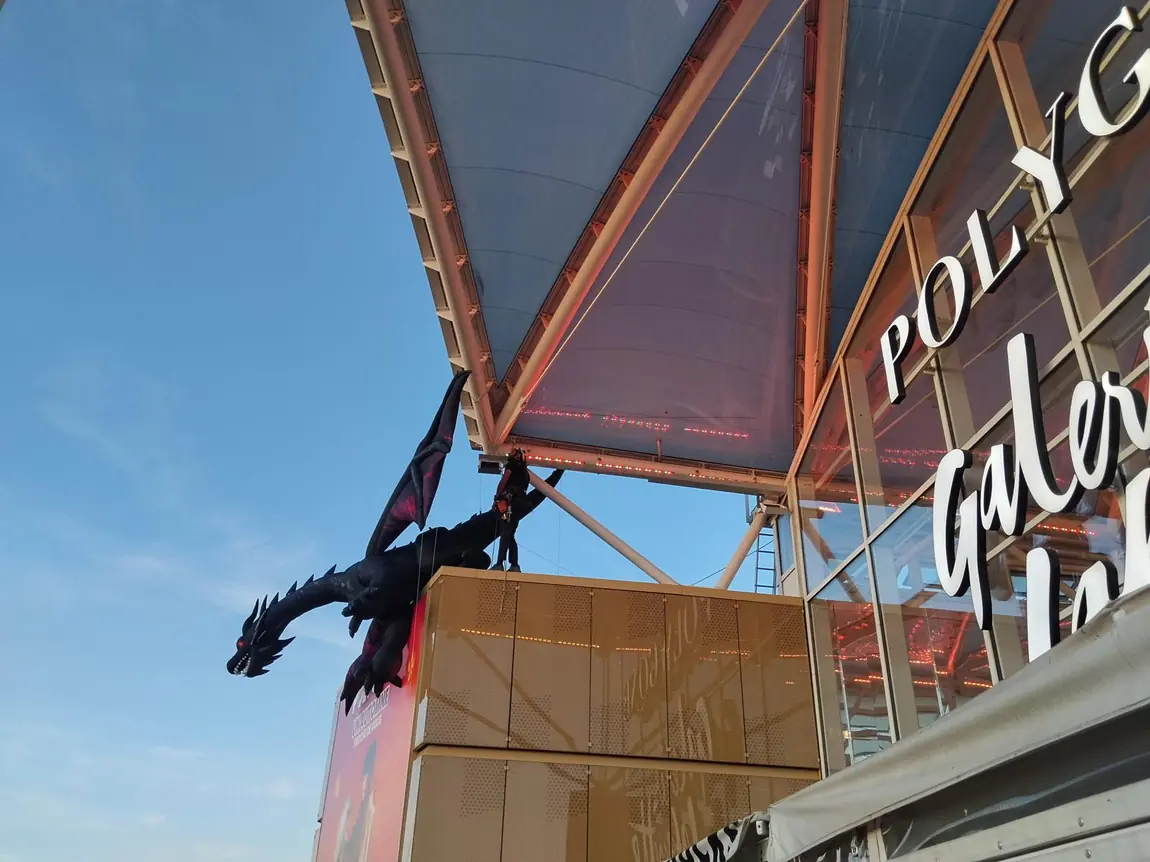
We don't ship a box with a manual.
- Space
- Footprint plus a clearance margin, and enough ceiling height for suspended pieces.
- Access
- Door and corridor widths for the folded piece, and a vehicle route up to the setup point.
- Power
- A dedicated circuit with a 30 mA RCD, running continuously for constant-air pieces.
- Anchoring
- Water or sand ballast, ground stakes or structural anchor points, depending on the survey.
- Outdoors
- A stated wind limit and a written fallback procedure, agreed before the event.
- Height
- Certified rope access technicians for suspensions, facades and roof structures.
Every site is surveyed before we commit. If the venue cannot take the piece safely, we say so and propose another format rather than adapt on the day.
Tell us what you want to see standing.
Five minutes to describe your project. A reply within 72 working hours, with a first feasibility opinion. No commitment.